
PHILADELPHIA — The long line of soccer coaches and admirers seeking to meet the featured speaker last Thursday snaked along a wall of the large meeting room before bending toward a small stage.
For some 40 minutes, Roberto Martínez greeted them with a handshake, smile and small talk, never showing a hint of impatience or irritation. Portugal’s charming national team boss had just completed an hour-long discussion at the United Soccer Coaches Convention, sharing his personal story and answering questions about Cristiano Ronaldo, the fast-approaching World Cup, tactical options and the sport at large.
With participants in the next scheduled session beginning to arrive, including former U.S. players Heather O’Reilly and Lori Lindsey, organizers marked the end of the line. By then, though, Martínez had engaged with almost everyone.
“Earlier, I saw him upstairs buying coffee for people he’d probably just met,” Lindsey said.
Less than five months before the World Cup — and 10 weeks before a friendly against the U.S. in Atlanta — the 52-year-old Spaniard was a popular figure at a four-day event billed as the “world’s largest annual gathering of soccer coaches.”
Most of the some 10,000 conventioneers are youth and college coaches, plus administrators and product exhibitors, from across America.
Martínez marveled at the enormity of it all and the intensity of engagement in U.S. soccer circles.
“The main impression I got is the sheer potential of USA soccer,” he said in an interview, bookended by additional appointments. “When you look at the numbers and how they affect so many players, when you look at the passion that exists and the culture behind it, you can understand that soccer, without being the No. 1 sport in the U.S., is quite scary.”

Martínez accepted the invitation to not only impart wisdom but to gain a better understanding of the landscape before the World Cup. He and longtime assistant Richard Evans continued gathering information about travel logistics, time differences, weather impact and many other factors.
Ranked No. 6 by FIFA and boasting an absurd array of talent, Portugal will arrive with high expectations after winning the UEFA Nations League last summer. Two Group K matches in Houston — against an intercontinental playoff winner and Uzbekistan — will precede a showdown with Colombia in greater Miami.
Before arriving stateside five days before his June 17 opener, Martínez said he doesn’t want to leave anything to chance.
“It’s such a complex World Cup compared to the last one; Qatar was the complete opposite in terms of everything was very centralized,” he said. The 2022 tournament in pint-sized Qatar was Martínez’s second World Cup in charge of Belgium, which failed to get out of the group stage after advancing to the semifinals and finishing third in Russia four years prior.
“I don’t want to be finding too many surprises during the competition,” which will take place at 16 venues in the U.S., Mexico and Canada, he said. “I want to manage the unexpected as much as I can, but it is the complexity of three countries, huge distances and logistics. You’re trying to avoid uncertainty — or kill uncertainty — that the players and the team could have in a journey like a World Cup.”
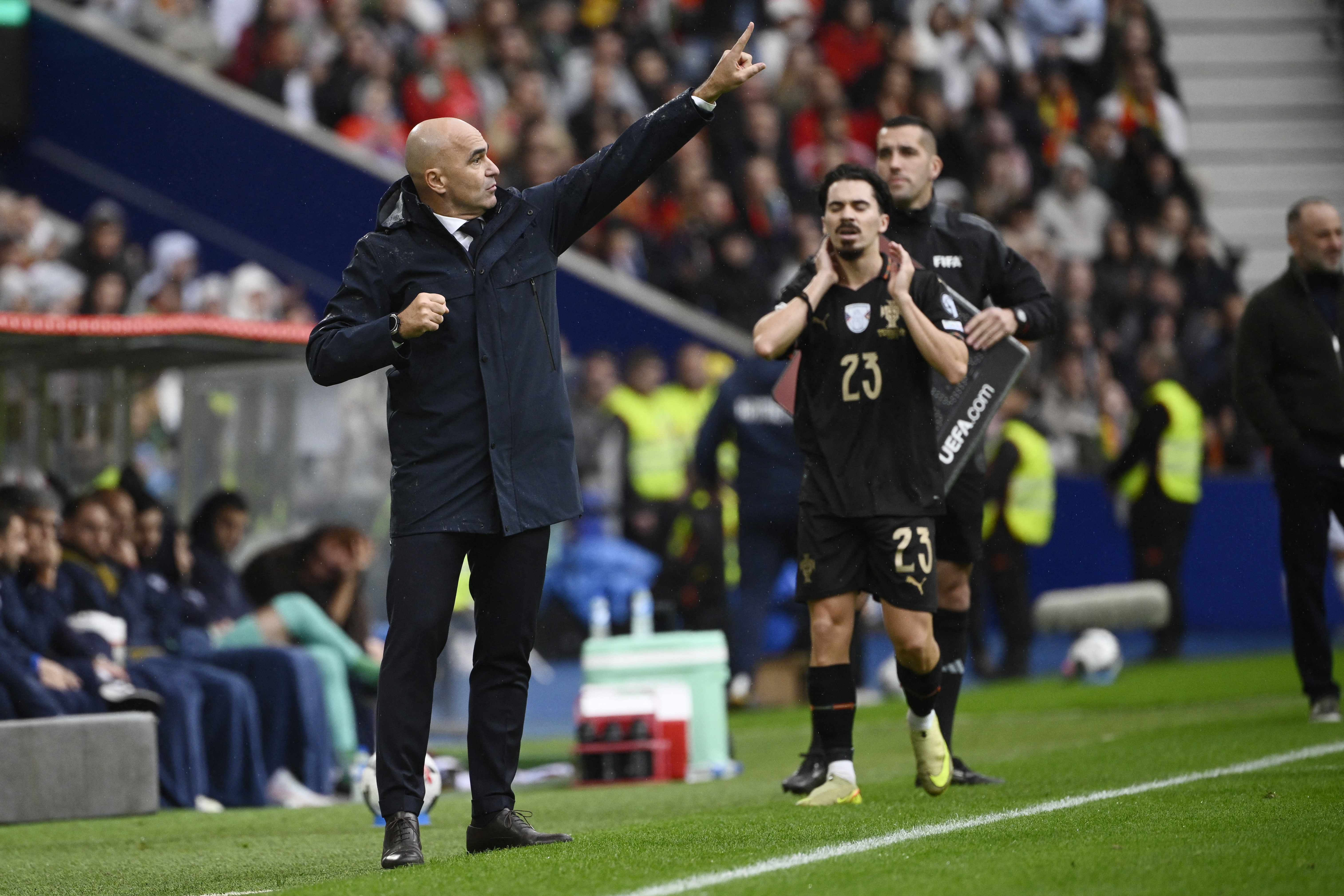
Portugal plans to set up base camp in the Miami area, even though the first two games are in Houston. It didn’t make sense to acclimate in Texas, Martínez noted, because NRG Stadium is indoors. By advancing to the knockout stage with a first- or second-place finish, Portugal would play in the Round of 32 in Kansas City, Missouri, or Toronto. Another victory would send it to an indoor venue in Vancouver or Arlington, Texas.
To help prepare for the World Cup, Martínez drew from his experiences last summer following the FIFA Club World Cup around the United States.
Martínez will use the March international window to further preparations with a March 28 friendly against Mexico at Estadio Azteca in Mexico City and a March 31 clash with the United States at Atlanta’s Mercedes-Benz Stadium. (Both are World Cup venues.)
“We are training at sea level [in Playa del Carmen, Mexico] and playing at high altitude [in Mexico City], which will allow us to have a lot of information of our performance in those conditions,” he said. “Then going to Atlanta in a closed stadium to match a little bit of what we’re going to experience” at the World Cup in Houston.
With the players facing up to 50 days on World Cup assignment, Martínez opted to use the March window for intensive work overseas. After at least a week off in May, Portugal will play two home friendlies before traveling to the U.S.
“The [club] season is so long for the players that you need to reduce to a minimum the preparation to the World Cup before the World Cup,” he said. “So you need to use as much time as you can at home to prepare. Priority No. 1 is: How can we kill mental fatigue for the players before a World Cup?”
Martínez is no stranger on the U.S. scene, which partially explained his popularity at the convention. He was an ESPN studio analyst on location at the 2010 and 2014 World Cup and 2012 and 2016 European Championship.
Martínez said he accepted ESPN’s 2010 offer in part to prepare himself for coaching in a World Cup someday. At the time, he was coaching Wigan in the Premier League.
“The season is so intense you have no time to look how you could prepare to be an international coach,” he said. “So my idea was [to] do it when I’m on holiday to follow a World Cup, to be part of the [ESPN] group of breaking the game down, but internally, to prepare myself to see how the national teams would prepare for the World Cup.”
He spent another summer with his Scottish wife Beth in Connecticut near ESPN headquarters to analyze the FIFA Confederations Cup. He has also assisted CBS Sports’ coverage of the UEFA Champions League.
He loved doing TV, saying during his Philadelphia seminar, “This is so easy, isn’t it? You look at what went wrong and you say what could have gone right? The problems when you are the coach, you have to guess before it happens. That’s the hardest thing, but to be on TV and talking about it is the easiest job in the world.”
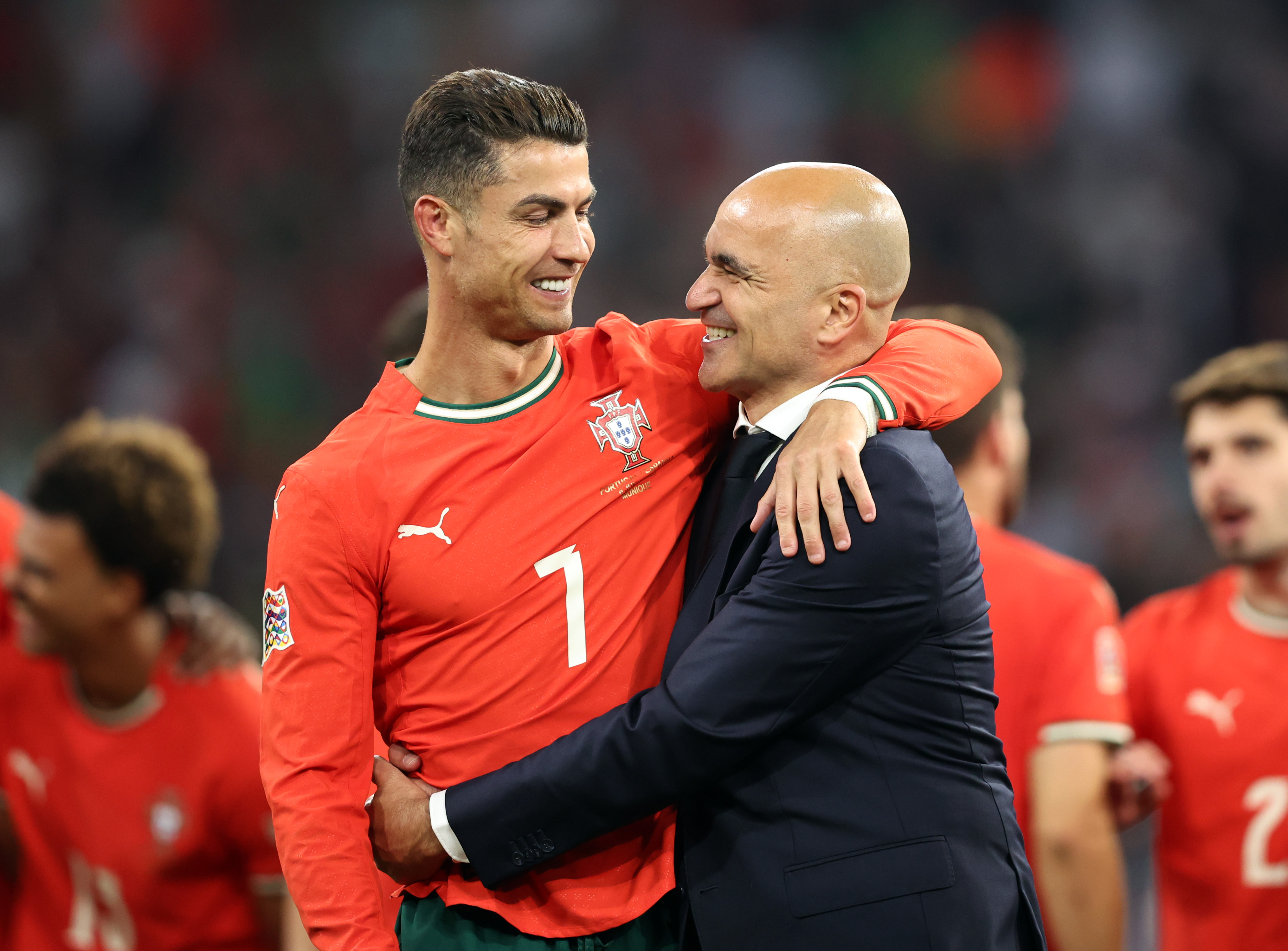
He’ll embrace the hard part this summer with Portugal, which has not advanced past the World Cup quarterfinals since finishing fourth in 2006 in Germany. He has a wealth of talent, featuring Ronaldo, Bruce Fernandes, Vitinha, Bernardo Silva, Rafael Leão, Nuno Mendes and Rúben Dias, among others.
The chemistry, though, needs to be just right.
“You don’t pick the best 26 players,” he cautioned at the seminar. “You pick the best 26 members that make the best team, which is a concept difficult to understand. If you’ve got a player that plays every minute and is the star of their [club] team and he comes to a national team and he can only play five or six minutes [as] a supportive player, it’s a completely different role. It’s very, very difficult to have a committed player in that role.”
Martínez says there are no such commitment issues from Ronaldo, who in 2022 clashed with then-coach Fernando Santos and lost his starting job at a major tournament for the first time in 14 years.
Ahead of his 41st birthday next month and his sixth World Cup, the legendary forward has “the passion and the hunger of a 16 years old,” Martínez said. “Every day is an opportunity for him to become better. It’s very difficult, after winning, to get up the next day with the same conviction. That’s what makes him different. I don’t know if it’s genetics or the habits he has created or a bit of both, but it’s a real example that is very rare.”
While Ronaldo remains a key figure, Martínez said selecting a starting lineup is not the same these days.
“We don’t work anymore with starting elevens,” he said. “This is something from the past. Now you’ve got five substitutions [instead of three]. If you only coach the first 11, you’re going to miss a big part of the preparation. … Some players will start; some players will finish the game. … There are no substitutes; there are game-changers.”
Since taking the Portuguese helm three years ago, Martínez has forged a 25-5-6 record. The 2024 European Championship ended with a shootout loss to France in the quarterfinals. A year later in the Nations League finals, Portugal defeated Germany in Munich and outlasted Spain in a championship shootout.
Now comes the World Cup, which has swelled from 32 to 48 teams — an expansion criticized by many but embraced by Martínez.
“A World Cup should be for everybody — the more teams, the better,” he said. However, he suggests a future format change that would reward the group winner with one fewer match in the knockout stage.
The tournament will unfold largely in a country with which he has grown familiar. Might he someday want to coach in the U.S.?
“I don’t think anybody could sit down and plan a career,” he said. “My only measurement or objective is to get to the end of the day and go to bed and say, ‘Yeah, I’ve done everything I had to do.’ My focus now is just to prepare Portugal the best possible way, and that’s it. The day I finish my contract, then it is a new opportunity, a new challenge.”